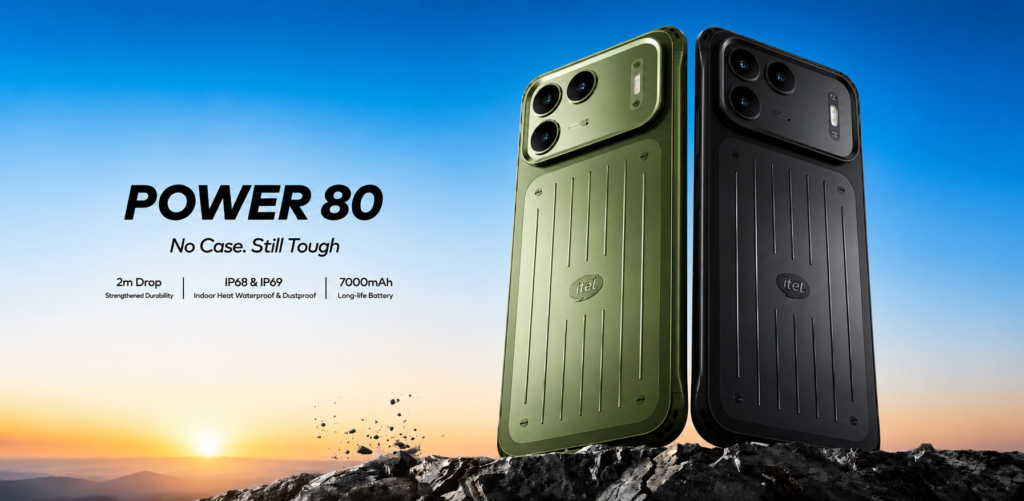

The Nigerian smartphone market continues to evolve, and itel has once again strengthened its presence in the budget segment with the launch of the itel Power 80. Officially introduced into the Nigerian market on June 23, 2026, the smartphone arrives as the successor to the itel Power 70, bringing several notable upgrades that focus on durability, battery life, performance, and artificial intelligence. Starting at approximately ₦186,900, the Power 80 is aimed at students, entrepreneurs, professionals, and everyday users who want a reliable smartphone without spending a fortune.
At first glance, the itel Power 80 stands out with its refreshed design and sturdy construction. Unlike many budget smartphones that prioritize appearance over durability, the Power 80 is engineered to withstand the challenges of daily use. The device comes with IP68/IP69 water and dust resistance, allowing it to survive exposure to rain, dust, and accidental splashes. It also features military-grade drop protection, giving users greater confidence that the phone can withstand accidental falls without suffering serious damage. This makes it especially appealing to people whose work often keeps them outdoors or in demanding environments.
The smartphone features a 6.78-inch HD+ display with a 120Hz refresh rate, delivering smoother scrolling and more responsive navigation than many competitors in its price range. Whether browsing social media, watching videos, reading documents, or playing casual games, the display offers a fluid user experience. Although the screen resolution remains HD+ instead of Full HD, it provides adequate brightness and vibrant colors that make everyday viewing enjoyable.
Don't MIss This Guide
Powering the device is the Unisoc Tiger T615 processor, which delivers dependable performance for routine tasks such as web browsing, video streaming, online classes, document editing, and multitasking between popular applications like WhatsApp, Facebook, TikTok, and Instagram. While the chipset is not designed for intensive gaming or demanding professional workloads, it performs efficiently for the needs of the average smartphone user. Combined with Android 16 and itel’s customized operating system, the phone provides a smooth and user-friendly experience enhanced by several AI-powered tools, including AI Writing Assistant, AI Translate, AI Voice Assistant, and intelligent image editing features designed to improve productivity.
Perhaps the biggest highlight of the itel Power 80 is its 7,000mAh battery, one of the largest available in its price category. The enormous battery easily lasts an entire day under heavy use and can extend to two days or more for moderate users. In a country where unstable electricity remains a challenge for many households, this feature alone gives the Power 80 a significant advantage over competing budget smartphones. itel also says the battery is designed to maintain its health over years of regular charging, helping users enjoy reliable performance long after purchase.
Photography on the Power 80 is handled by a 50-megapixel AI rear camera, which captures detailed and colorful images in good lighting conditions. The camera software intelligently recognizes different scenes and automatically adjusts settings to improve image quality. The 8-megapixel front camera performs well for selfies and video calls, making it suitable for students attending online lectures, professionals participating in virtual meetings, and users who regularly create content for social media. As expected from a budget smartphone, low-light photography is less impressive, with some reduction in sharpness and detail during nighttime shooting.
Don't MIss This Guide
The itel Power 80 enters the Nigerian market with a starting retail price of around ₦186,900, although prices may differ slightly depending on the storage configuration and retailer. During its launch campaign, buyers also benefited from several promotional offers, including a free smartwatch, an extended three-year warranty, complimentary screen replacement, MTN data bonuses, Boomplay Premium subscription, and MovieBox VIP access. These incentives significantly increased the phone’s value and made it one of the most attractive budget smartphone launches of the year.
Early reactions from Nigerian users have been largely positive. Many owners have praised the phone’s exceptional battery life, describing it as one of the few budget devices capable of lasting through extended periods without needing a recharge. Users have also applauded its rugged construction, smooth display, generous storage options, and dependable everyday performance. Several reviewers noted that the Power 80 feels more premium than its price suggests and appreciated the confidence that comes with its water resistance and drop protection. However, some users observed that the HD+ display is not as sharp as Full HD alternatives, while others felt that gaming performance and charging speed could have been better. Even so, these criticisms are relatively minor considering the phone’s affordable pricing.
As the direct successor to the itel Power 70, the Power 80 introduces meaningful improvements rather than cosmetic updates alone. It offers a larger battery, enhanced durability with IP68/IP69 certification, stronger drop resistance, improved AI software, a more capable processor, and an updated design that gives the device a more modern appearance. These upgrades make it a worthy replacement for its predecessor and position it as one of the most competitive budget smartphones currently available in Nigeria.
Overall, the itel Power 80 successfully delivers on its promise of combining affordability with practicality. Instead of competing directly with premium flagship smartphones, it focuses on solving the everyday challenges faced by millions of Nigerians by providing long battery life, dependable performance, rugged durability, and useful AI features at an accessible price. For buyers seeking a smartphone that can comfortably handle daily activities while offering outstanding value for money, the itel Power 80 is undoubtedly one of the best budget smartphones released in Nigeria in 2026.