

Plenty of Nigerians have bought a 5G phone, seen the 5G icon appear once, and never seen it again. Others have never seen it at all and wonder whether the whole thing is marketing. Both experiences make sense once you look at the actual numbers, because coverage in Nigeria is far patchier than the adverts suggest.
Here’s how to find out where you actually stand, in about half a minute.
Check Your Exact Address in 30 Seconds
Skip the city lists for a moment. Your street is what matters.
1. MTN Coverage Locator
Go to coverage.mtn.ng, switch to the 5G view, and type your exact address or drop a pin. Green means 5G, yellow means 4G only, red means limited coverage.
This is the most reliable single check available, simply because MTN has the largest 5G deployment in the country by a wide margin.
2. Ookla’s 5G Map
Open the Ookla 5G map and zoom into your area. The dots are real speed tests run by real users on real phones.
This is the honest counterweight to operator maps. It shows where 5G actually works, not where it’s claimed to exist, which is a meaningful difference in Nigeria.
3. nPerf
nPerf’s Nigeria map works similarly, with community-submitted signal reports and heatmaps you can filter to 5G.
4. Just Ask
Dial 300 from your line and ask about 5G at your address. That’s now the standard customer care number across MTN, Airtel, Glo and T2 following the NCC’s move to harmonise short codes, so it works whichever SIM you’re on. Airtel doesn’t publish a public 5G map, so calling or visiting a store is your best route there.
The Numbers Nobody Puts in the Adverts
Nigeria’s 5G story is four years old now and still early.
MTN launched commercially in September 2022, Airtel followed in June 2023. By early 2026, around 7.2 million Nigerians were connected to 5G. That sounds like a lot until you set it against the 188 million active mobile subscriptions the NCC counted in April 2026.
On population coverage, the NCC put 5G at about 12% of Nigerians in March 2026, with a stated target of 20% by the end of the year. Meanwhile 4G holds roughly 53.8% of the market and 2G still accounts for about 36.7%, which tells you plenty about the device gap.
| Operator | Status | Where |
|---|---|---|
| MTN | Live since September 2022 | Around 2,100 sites across 13 cities. Widest network by far |
| Airtel | Live since June 2023 | Doubled its active 5G sites across Nigeria’s top 20 cities during 2025 |
| Mafab | Licensed December 2021, still no verified commercial service | Nothing you can actually connect to |
Mafab paid for its licence at the same auction MTN did and has now missed launch deadlines repeatedly, most recently a promised Q1 2025 rollout. If a seller tells you Mafab 5G is an option, it isn’t.
Covered City Does Not Mean Covered Street
This is the part that catches people out, and it’s worth being blunt about.
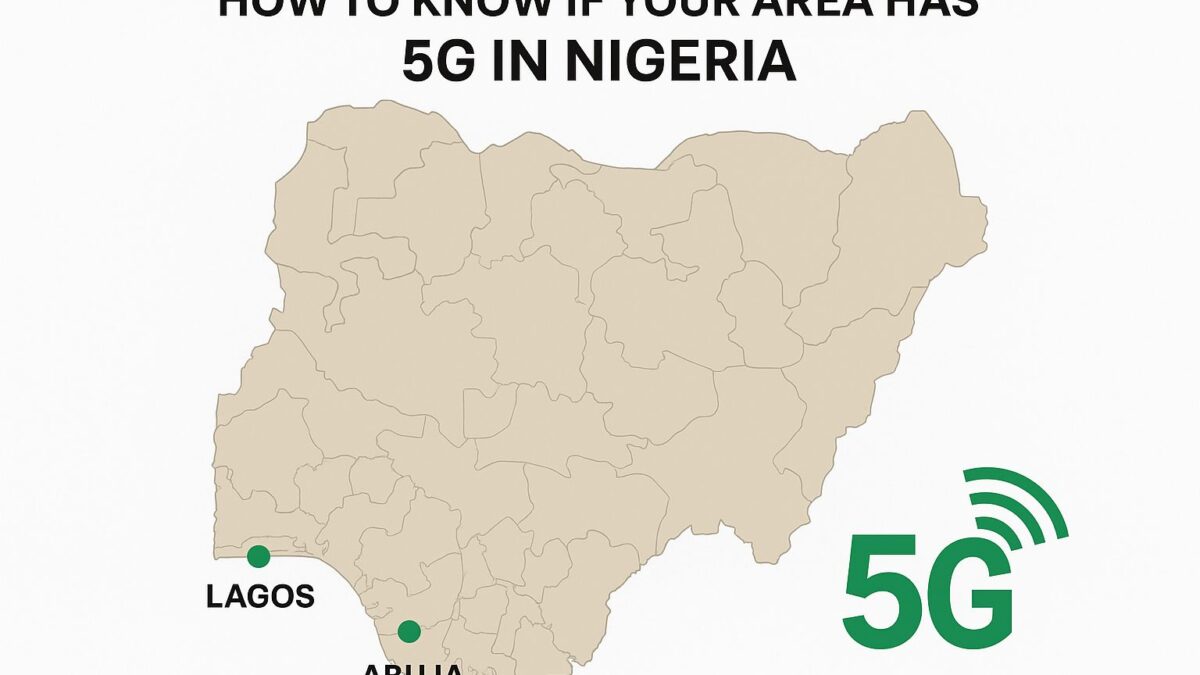
NCC figures from Q4 2025 showed that even in Lagos, more than half the state had no 5G coverage at all, and in Abuja close to half the capital was uncovered. Those are the two most connected places in the country.
Where 5G does exist, it clusters in predictable places: central business districts, high-income neighbourhoods, big shopping areas, university campuses and tech hubs. Lagos VI, Lekki, Ikoyi, Abuja Central and Port Harcourt GRA get the strongest MTN signal. Airtel is strongest around Lagos Mainland, Ikeja and central Abuja.
Suburban and rural areas are almost entirely outside it. The NCC has also flagged that hundreds of kilometres of major Nigerian roads have no network coverage of any generation, not even 2G, which puts the 5G conversation in perspective.
Cities With Confirmed Coverage
MTN’s 5G reaches Lagos, Abuja, Port Harcourt, Kano, Ibadan, Maiduguri, Owerri, Warri, Enugu, Benin City and Abeokuta, among others. Airtel’s early rollout covered Lagos, Ogun, Abuja, Rivers and Osun, and it has since expanded across the top 20 cities.
Treat this as a shortlist for checking, not a guarantee. Run your address through the maps above regardless.
Your Phone Might Be the Problem
If you’re standing in a covered area and still not seeing 5G, work through these.
Does your phone support the right bands?
Nigeria runs 5G mainly on n78 (3500 MHz), used by both MTN and Airtel, with n38 (2600 MHz) as an Airtel capacity band. A phone sold as “5G” in another market may not support these.
Broadly, iPhone 12 and newer, Galaxy S21 and newer, Pixel 5 and newer, and most flagships from 2021 onwards will work. If you’re unsure, search your exact model plus “5G bands” rather than assuming. Here’s how to check your Android version and phone details if you need them.
Is 5G actually switched on?
Android: Settings, then Connections or Network & Internet, then Mobile Networks, then Network Mode. Pick the option that includes 5G.
iPhone: Settings, then Mobile Data, then Mobile Data Options, then Voice & Data. Choose 5G On or 5G Auto.
Is your SIM old?
SIMs from before roughly 2020 may not support 5G. MTN will swap yours free at any store if you bring valid ID. On Airtel, dial *321# and look for the SIM upgrade option, or visit a store.
The 5G Icon Is Lying to You (Sometimes)
Seeing 5G in your status bar but getting ordinary speeds is a common complaint, and there are real reasons for it.
- Non-standalone 5G. Most deployments here run alongside 4G infrastructure. Your phone can show the 5G icon because it’s connected to a 5G tower, while your actual traffic still travels partly over 4G.
- Congestion. Small coverage islands with many users on them, which is exactly what Lagos VI and Lekki look like during business hours.
- Edge of coverage. 5G signals are blocked by walls and buildings far more easily than 4G. Moving one room over can kill it.
- Plan throttling. Some bundles slow down after a usage threshold.
The only real test is a speed test. Run Ookla Speedtest. Consistently over 100 Mbps means you’re genuinely on 5G. In good conditions MTN’s 5G delivers roughly 400 Mbps to 1 Gbps and Airtel’s around 300 to 700 Mbps, against 10 to 50 Mbps on typical 4G.
If speeds are poor across the board rather than just on 5G, that’s a different problem. Our guide on fixing slow MTN internet at home covers that.
Why Rollout Is This Slow
- Cost. A single 5G base station runs to roughly $1.2 million here, far above what operators pay in markets like China, and the foreign exchange situation makes imported equipment brutally expensive.
- Devices. 5G phones still start around ₦300,000, while a large share of Nigerians are on 2G-only handsets. Networks won’t build out faster than people can connect.
- 4G is good enough. It covers most urban areas and handles what most people do. That weakens the commercial case for rushing.
- Fibre. Nigeria has a large fibre backhaul deficit, and cables get cut during road construction. 5G towers need fibre behind them to be worth anything.
- Money. Most people choose cheaper data over faster data, every time.
Things are moving, though. Airtel added thousands of new sites during 2025 and expanded its fibre backbone by around a quarter, while MTN continues to extend its footprint. Realistically, meaningful 5G across the majority of Nigeria’s top 20 cities is a 2029 conversation, not a 2026 one.
Is It Worth Upgrading?
| 4G LTE | 5G | |
|---|---|---|
| Typical download | 10 to 50 Mbps | 300 to 1000 Mbps |
| Latency | 30 to 50ms | 15 to 20ms |
| Streaming | Smooth HD | Comfortable 4K |
| Gaming | Playable, some lag | Near-instant response |
| Nigerian coverage | Majority of the market | Around 12% of the population |
| Phone cost | From about ₦50,000 | From about ₦300,000 |
| Data cost | Standard | Noticeably higher |
5G bundles cost more than 4G ones, and the exact difference shifts with promotions, so check current pricing in your network’s app rather than trusting any figure you read in an article, including this one.
Go for 5G if the maps confirm coverage at the places you actually spend your time, you already own or were going to buy a compatible phone anyway, and you move large files, stream heavily or need low latency for work or competitive gaming.
Stay on 4G if your address isn’t covered, your current speeds already handle what you do, or the ₦300,000-plus phone and pricier bundles would hurt. For social media, messaging, video calls and HD streaming, 4G is genuinely fine and will remain so for years.
If You’re Not Covered Yet
- 4G still does the job. MTN has the broadest national reach, Airtel is strong on urban speed and pricing, Glo is cheaper but less consistent.
- Fixed wireless is often the better answer for home internet. MTN HyperNet, Airtel’s home broadband and Smile all reach places mobile 5G doesn’t. Our roundup of the cheapest unlimited WiFi plans in Nigeria compares the options.
- Don’t buy a 5G phone for 5G alone. Buy it because it’s a good phone. If coverage arrives later, treat that as a bonus.
One last thing worth saying plainly, since it still circulates: 5G uses non-ionising radiation in the same broad range as your WiFi router, and the WHO and other international health bodies have found no credible evidence it harms health. The COVID-19 claims were thoroughly debunked years ago.
Check your exact address on MTN’s locator and cross-check it against Ookla’s real-user map. If both say yes, 5G is genuinely worth having. If they don’t, keep your money, because 4G handles almost everything most people do and will for some time yet.


Join the conversation