
After receiving complaints from students over duplicate tuition payments, the Nigerian Education Loan Fund (NELFUND) is redesigning how school fees will be disbursed under the federal student loan programme.
The agency says it is developing a digital payment model that will allow beneficiaries to complete tuition payments themselves through a secure token, a move expected to reduce payment errors and improve accountability.
The proposed system marks a departure from the current arrangement in which NELFUND transfers tuition fees directly to tertiary institutions after approving a student’s loan application.
The introduction of the student loan programme brought financial relief to thousands of students, but it also exposed challenges in tuition disbursement.
Because many institutions required students to pay their fees before registration or examinations, some applicants settled their tuition while waiting for their loans to be processed. When NELFUND later released the approved funds, a number of schools received payments twice for the same student.
Don't MIss This Guide
Currently NELFUND alongside EFCC is investigating 34 tertiary institutions over allegations that they failed to refund students whose tuition fees were paid twice under the federal government student loan scheme.
Rather than continuing with a process that allows such situations to occur, the agency says it is redesigning the payment system to make tuition disbursement more efficient.
Under the proposed arrangement, approved tuition funds will be converted into a secure digital token instead of being sent immediately to institutions.
Once a student is ready to complete school registration, the token can be presented at the bursary to authorise payment electronically.
Don't MIss This Guide

Explaining the idea during an interview on ARISE News, NELFUND Managing Director Akintunde Sawyerr said students would be able to initiate payment themselves “through a token.”
According to the agency, this approach gives beneficiaries greater flexibility while ensuring that tuition payments are completed only when required.
Although students will have more control over the payment process, NELFUND says tuition funds will still remain protected.
The agency believes transferring school fees directly into personal bank accounts could increase the risk of funds being diverted to other expenses.
Instead, the token system is intended to strike a balance by allowing students to authorise payments without giving unrestricted access to the tuition funds.
Monthly upkeep allowances, however, will continue to be credited directly to beneficiaries as they are under the current arrangement.
The proposed upgrade comes as participation in the student loan programme continues to increase.
Since applications opened in 2024, well over one million students have received financial support for tuition and upkeep, while total disbursements have exceeded ₦206 billion.

According to the student loan disbursement dashboard as of July 4th,2026.
1. Applicate– 1,800,489
2. Beneficiaries – 1,635,676
3. Institutional fees paid -190,061,319,780.25
4. Upkeep allowance paid -113,847,132,000.00
5. Total loan disbursed – 303,908,451,780.25
Don't MIss This Guide

As the number of beneficiaries grows, NELFUND says improving the payment process has become necessary to maintain efficiency and public confidence in the scheme.
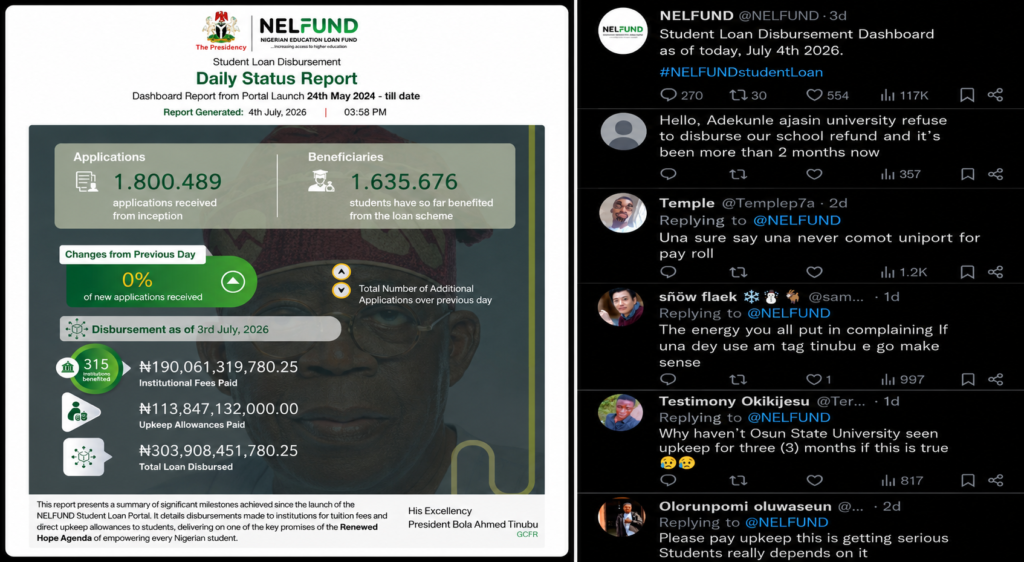
Regardless of these humongous figures mentioned, most students testified that they are still yet to confirm their student upkeeping allowance for a very long period of time .
The token-based payment system has not yet been rolled out, but preparations are underway.
Once introduced, the new process is expected to reduce duplicate payments, simplify tuition disbursement, and strengthen transparency in the management of education loans.
For prospective beneficiaries, the change could mean a faster, more reliable, and better-coordinated payment process that aligns more closely with institutions’ academic calendars.